
At Rejuvenators, many clients tell us the same thing after a massage:
“I wish I could feel like this every day.”
The good news is there’s a simple tool you can use anywhere — at your desk, before sleep, before a meeting, or even while travelling — that helps your body return to that calmer state more easily.
It’s called box breathing.
And it works faster than most people expect.
What is box breathing?
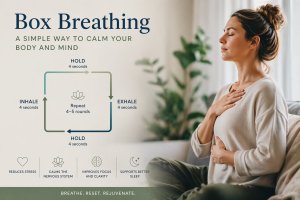
Box breathing is a structured breathing pattern:
Inhale — hold — exhale — hold
Each step usually lasts about four seconds, forming a steady rhythm like the four sides of a square.
For example:
- breathe in for 4 seconds
- hold for 4 seconds
- breathe out for 4 seconds
- hold for 4 seconds
Repeat this for 4–5 rounds.
That’s enough to begin shifting your nervous system.
Why breathing affects stress so quickly
Most stress-management strategies work “top-down” — trying to change thoughts first.
Breathing works bottom-up.
It sends signals directly to your nervous system through the vagus nerve, helping your body move from “fight-or-flight” mode toward a calmer “rest-and-recover” state.
One of the key physiological markers influenced by slow breathing is heart rate variability, a measure linked with emotional regulation, resilience, and recovery from stress. A large meta-analysis of more than 200 studies found that voluntary slow breathing reliably increases HRV and supports parasympathetic (calming) nervous-system activity.
In simple terms:
slow breathing tells your body it is safe.
And when the body feels safe, the mind follows.
What box breathing does inside your body
Research into slow breathing techniques shows measurable effects across several systems in the body, including:
Lower heart rate
Slow breathing improves coordination between breathing and cardiovascular rhythms.
Reduced stress chemistry
It helps quiet the body’s stress response.
Improved nervous-system balance
Breathing rhythm influences the balance between alertness and relaxation.
Better attention and clarity
Structured breathing activates areas of the brain responsible for focus and emotional regulation.
Controlled breathing practices affect respiratory, cardiovascular and autonomic nervous-system function — all key regulators of stress and recovery.
That’s why athletes, pilots, therapists, and medical professionals all use breathing techniques like this in high-pressure situations.
Why box breathing works so well for busy people
Many people assume relaxation requires long meditation sessions or major lifestyle changes.
Box breathing is different.
It works because it is:
- simple
- structured
- portable
- fast
- and repeatable anywhere
Even five breaths can begin shifting how your body feels.
That makes it ideal between meetings, before sleep, during travel, or before walking into a stressful situation.
A perfect companion to massage therapy
Massage helps release physical tension stored in muscles and connective tissue.
Box breathing helps release tension stored in the nervous system.
Together, they support:
- deeper relaxation
- improved sleep
- clearer thinking
- reduced stress load between treatments
Many clients find that adding a short breathing practice helps extend the benefits of their massage for longer.
Think of it as a daily “mini reset” for your body.
Try this one-minute reset now
Sit comfortably.
Relax your shoulders.
Then follow this pattern five times:
Inhale for 4 seconds
Hold for 4 seconds
Exhale for 4 seconds
Hold for 4 seconds
That’s it.
Most people notice a shift almost immediately.
A small habit that makes a real difference
Modern life moves quickly.
Screens, notifications, deadlines, and constant information keep the nervous system switched on longer than it was designed to be.
Box breathing is one of the simplest ways to switch it off again.
It’s free.
It takes less than a minute.
And it’s one of the easiest gifts you can give yourself between massage sessions to support calm, clarity, and wellbeing throughout the day.