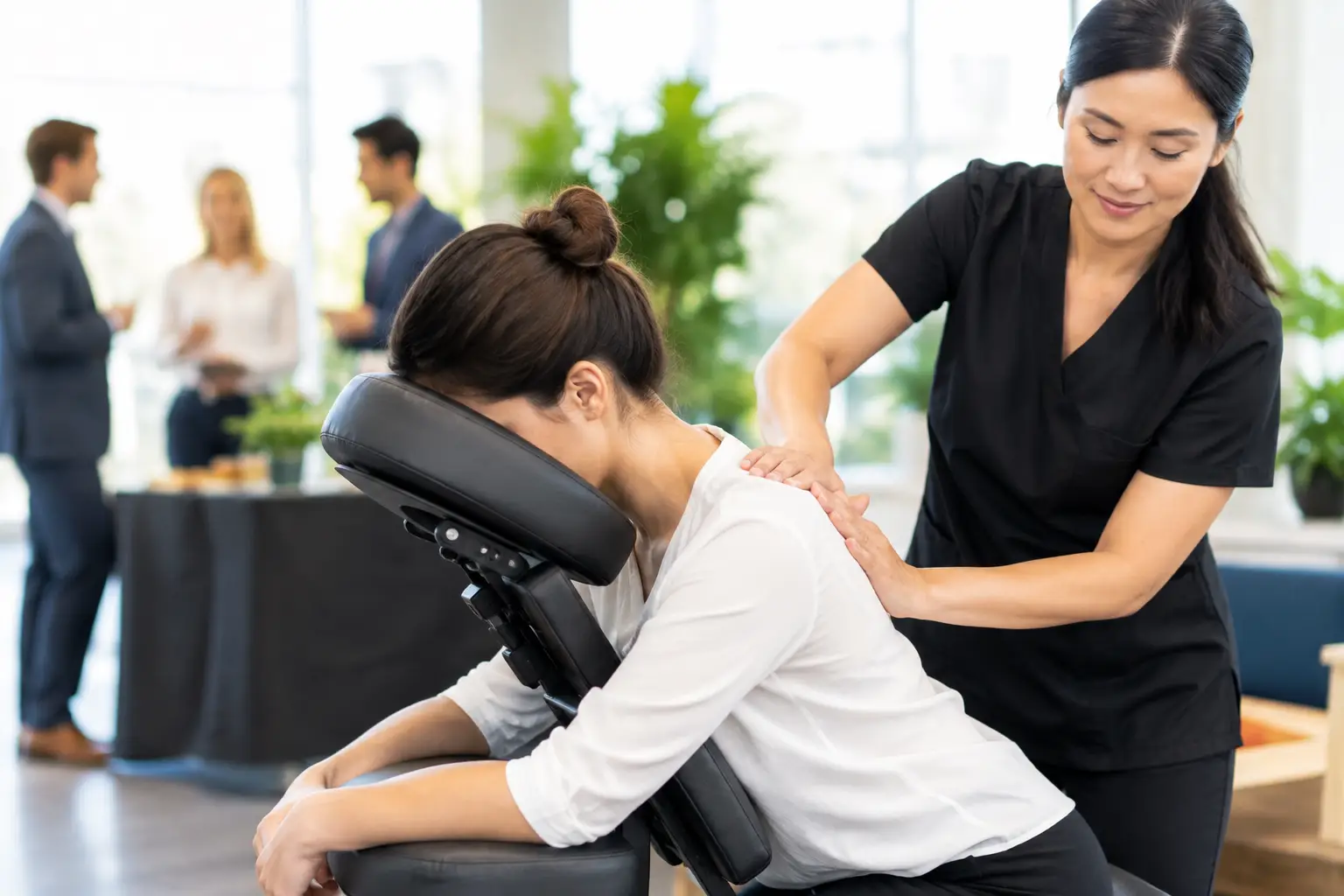
A full event schedule can look impressive on paper and still leave people depleted by mid-afternoon. Chair massage events create a considered pause within the day: a short, focused treatment that helps guests release upper-body tension, reset their attention and return feeling genuinely cared for.
For employers, hotel teams and event organisers, the appeal is practical as well as personal. There is no need for attendees to change clothes, no requirement for treatment rooms and no long interruption to the programme. With qualified practitioners, a well-positioned massage station and a clear booking flow, chair massage becomes a polished part of the guest experience rather than an awkward add-on.
What happens at a chair massage event?
Chair massage is delivered on a purpose-built ergonomic massage chair. The guest remains fully clothed, supported through the chest and face cradle, while the practitioner works primarily on the neck, shoulders, upper back, arms and hands. These are the areas that often carry the load of desk work, travel, presentations and long days on the feet.
Sessions usually run for 10 to 20 minutes. That is enough time for a tailored, effective treatment without pulling someone away from a conference, staff activation or celebration for too long. Oils are generally not required, which keeps the experience tidy and makes it suitable for shared workplaces and venues.
A quality treatment is not a fixed routine. The practitioner should ask a few discreet questions before beginning, then adjust pressure and focus to the guest’s comfort. One person may need gentle work around a tight neck after a flight; another may prefer firmer attention through the shoulders after a week at a laptop. The goal is relaxation and relief, never to push through discomfort.
Why chair massage events work so well
The best hospitality and workplace experiences recognise that people do not have unlimited energy. A thoughtful wellness offering signals that their comfort matters, especially during a busy programme where meals, coffee and branded merchandise are already expected.
For corporate teams, chair massage can provide a welcome circuit-breaker during wellness weeks, planning days, end-of-year gatherings and periods of high workload. It is not a substitute for sensible workload management, ergonomic set-up or clinical care when pain is ongoing. It can, however, give people a tangible moment of physical release and encourage them to take their wellbeing seriously.
At conferences and trade events, a massage station can help draw people into a quieter part of the venue, reward delegates between sessions or add real value to a VIP lounge. Hotel partners may use it for group arrivals, executive retreats or incentive programmes, where an in-room or on-site treatment adds a premium layer without requiring every guest to leave the property.
There is also a simple operational advantage. Compared with table massage, chair massage requires less space and has a faster turnover. It suits event environments where time, floor space and guest movement all need careful management.
Plan the experience around people, not just the timetable
A successful event starts by estimating demand honestly. If 80 people are invited and each session lasts 15 minutes, one practitioner can only treat around four people per hour once brief consultations and changeovers are included. A two-hour activation with one therapist may suit a small team. A larger conference or all-day staff event will usually need several practitioners or a booking system that manages expectations.
It is better to offer fewer treatments well than advertise an open queue that leaves guests disappointed. Consider whether the purpose is broad access, with shorter sessions for many people, or a more premium experience with longer treatments for a smaller group. Neither approach is inherently better. It depends on the audience, the timing and what the event is intended to achieve.
Choose a calm, visible location
The massage station should be easy to find without becoming a spectacle. A quiet corner near, but not inside, the main event flow often works best. Guests should be able to approach comfortably, and practitioners need enough room to move around the chair safely.
Avoid placing the set-up beside speakers, a crowded bar or a busy registration queue. Noise affects relaxation, and a lack of privacy can discourage guests who would otherwise enjoy the treatment. In larger venues, a screened area can create a more composed, premium feel while still allowing clear signage and access.
Make booking simple
Walk-up sessions can work well for casual activations with low demand. For corporate days and conferences, timed bookings are usually more reliable. They reduce queues, make the schedule fairer and help people fit a session around meetings or presentations.
A visible schedule, clear session length and an easy way to join a cancellation list keep the experience organised. Let guests know that they should arrive a few minutes early and that treatments are performed fully clothed. Small details reduce uncertainty and increase participation.
Practitioner quality shapes the whole event
A massage chair alone does not create a professional service. The standard of the practitioner is what makes guests feel safe, listened to and properly cared for. Event providers should supply appropriately qualified, experienced therapists who understand how to work efficiently in a public setting while maintaining calm, respectful communication.
Hygiene, presentation and consent matter just as much as technique. Equipment should be clean and professionally maintained, with fresh face-cradle covers or appropriate sanitary barriers between clients. Practitioners should explain what to expect, check comfort and pressure, and give guests an easy opportunity to decline any area of work.
Some guests may have injuries, recent surgery, acute pain, skin conditions or other health considerations that mean massage is not appropriate that day. A capable practitioner will screen briefly and make a safe call. This is not a limitation of the service; it is part of delivering care responsibly.
For large events, consistency is especially valuable. Rejuvenators brings the experience of a long-established mobile wellness provider to workplace, hotel and venue settings, with practitioners who can deliver a composed guest experience while adapting to the pace of the day.
Set the right expectations for outcomes
Chair massage can help guests feel looser, calmer and more comfortable, particularly through areas affected by posture and stress. Many people notice that their shoulders feel less elevated, their head feels clearer or that they can take a deeper breath after a short session.
Results vary. A 15-minute treatment cannot resolve a long-standing injury, chronic pain condition or complex mobility issue. It is most valuable when positioned honestly: a restorative, personalised reset that supports wellbeing in the moment. Guests with persistent or severe symptoms should seek appropriate medical or allied health advice.
That honesty builds trust. It also prevents a common mistake in event planning – promising a transformative treatment when the format is designed for accessible relief and relaxation.
Add value without overcomplicating the day
Chair massage stands well on its own. It does not need a loud theme, elaborate décor or a complicated rewards mechanic to feel special. Often, the most refined approach is a clean, welcoming station, skilled practitioners and enough time for each guest to settle in.
If the event has a broader wellbeing focus, chair massage can sit naturally alongside hydration, healthy catering, a quiet recharge space or short mobility sessions. Keep the overall message consistent: this is time set aside to recover, recharge and return to the day with more ease.
The practical details matter too. Confirm access times, parking or loading arrangements, venue contacts, lift access and bump-in requirements before the day. Ensure the event organiser knows where power is available if needed, although chair massage itself generally has minimal technical requirements. A clear run sheet gives practitioners the information they need while allowing them to focus on guests once service begins.
A memorable pause is often the most valuable one
People may not remember every slide, canapé or name tag from an event. They do remember how the experience made them feel. A well-run chair massage session offers something increasingly rare in a busy schedule: a few uninterrupted minutes of expert attention, physical comfort and genuine care.
When planned with realistic capacity, qualified practitioners and a setting that protects calm, it becomes more than an event extra. It is a practical way to help people reset, recover and feel welcomed.